The AI+Well-Being Institute, explores how artificial intelligence can enhance human flourishing, strengthen communities, and support adaptive public policy in times of rapid change. Our work bridges research, education, and practice; combining primary research, narrative analytics, cultural insight, & student-led projects to address urgent societal challenges. By treating well-being as the true measure of progress, we position AI not as a distant technology, but as a present-day tool for resilience, creativity, and equity. This institute is both a research hub and a learning platform, designed to equip the next generation with the skills and imagination to shape a thrivable future.
Located within the ICLA (International College of Liberal Arts in Japan), the Institute collaborates with many international & local organisations, such as the Universities of Tokyo & Melbourne & Significance Systems.
Our Work & Research
Complex adaptive systems need diversity to function well. Modern life increasingly replaces that diversity with narrow, optimised signals. The result is brittleness, distortion, and hidden failure across mind, society, and institutions. What looks efficient in the short term quietly destroys the conditions for human flourishing.

Why do very different languages converge on a similar communication rate? Our new paper argues that language is not built to maximize information, but to achieve shared understanding through noise, ambiguity, and repair. Communication, we suggest, works by compressing meaning across shared worlds.
Why do language models feel creative at all? This paper argues that the answer may lie not in seamless global understanding, but in the local patterns of human language.
Modern life runs your nervous system on three channels. There are about a hundred ... The missing ones are why ordinary experience stops feeling like enough — and why more stimulation never fixes it. Two papers on what's actually going on, and what to do about it.
Most books try to communicate clearly. Finnegans Wake does something stranger: it keeps generating meaning faster than we can close it down. Our Research project uncovers it's structural singularity & asks whether that structure comes from an extraordinary density of meaning.
Sleep may do far more than store memory. Our new model suggests the sleeping brain actively edits experience, pruning noise and preserving what matters most. In computational terms, sleep may be solving a compression problem.
Football is a team sport ! Yet the analytics that shape transfer decisions and team selection still treat squads as collections of individuals. We can see how this approach ultimately impacts the way the game is played - 25/26 EPL being a clear example. Our research programme addresses the gap — extending classical models to capture the interaction effects that determine whether a group of talented players actually performs as a team.
The search for extraterrestrial life may be scientifically active yet structurally unable to deliver an answer on human timescales.
AI Won’t Lead … But your People Will. Chris Lowndes, AI lead for Accenture & John Ricketts hold a series of workshops & discussions with ICLA students. Here we introduce the Value Creator 2035 blueprint — five human competencies our curriculum is engineered to build, and why they matter for your future talent pipeline. Watch the videos, read the findings. Get ready for the future … that’s where you’ll spend the rest of your Life !
Policy failures from climate shocks to pandemic mismanagement reveal the inadequacy of static, prediction based governance. “This is not a call to optimism, but to capability… to listen deeply, design bravely & fail intelligently”
Safer AI is possible. The tools already exist — but many are not used because they slow growth and hurt engagement metrics. Our new paper argues that AI safety is not just a model problem, but an institutional one.
The Wellbeing Observatory is an ongoing research Project at the AI+Wellbeing Institute. Based upon a novel approach to quantifying contribution or detracts from wellbeing. This interactive global dashboard that visualizes “wellbeing efficiency” - the extent to which economies support or detract from wellbeing - across countries from 1970 to today.

This simulation provides an interactive exploration of the empirical relationships between personality, cognition, and authoritarian attitudes as established in the peer-reviewed literature. It is designed for educational use in courses covering political psychology, personality research, and social cognition
Global GDP has tripled since 1970, but life satisfaction in wealthy nations has barely moved. Our paper argues that the key issue is not how much economies grow, but where that growth goes. What matters for wellbeing is spending composition, not spending alone.
To make AI safer, we need more than technical skill. We need people who can connect evidence, values, history, culture, and governance. That is what liberal arts brings to AI safety.
The Dark Enlightenment is no longer just fringe theory. Its anti-democratic logic now echoes through parts of Silicon Valley and the New Right. This critique examines how those ideas moved from the margins toward power.
What happens to purpose in a world where AI can do so much? This short documentary follows a personal journey of losing direction, then finding it again through reflection, family, and the Ikigai model. It asks what remains uniquely human — and where meaning can be found, and nurtured.
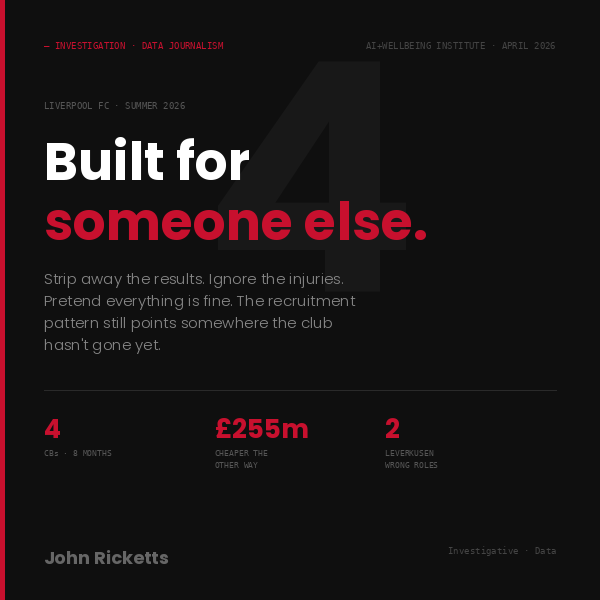
What does it look like when a club builds for a manager who hasn't arrived yet? We mapped every major Liverpool signing across 18 months. The data points somewhere Anfield hasn't gone. And getting there costs £255m less than staying where they are. This is what investigative data journalism looks like — applied to the biggest club story of the summer.
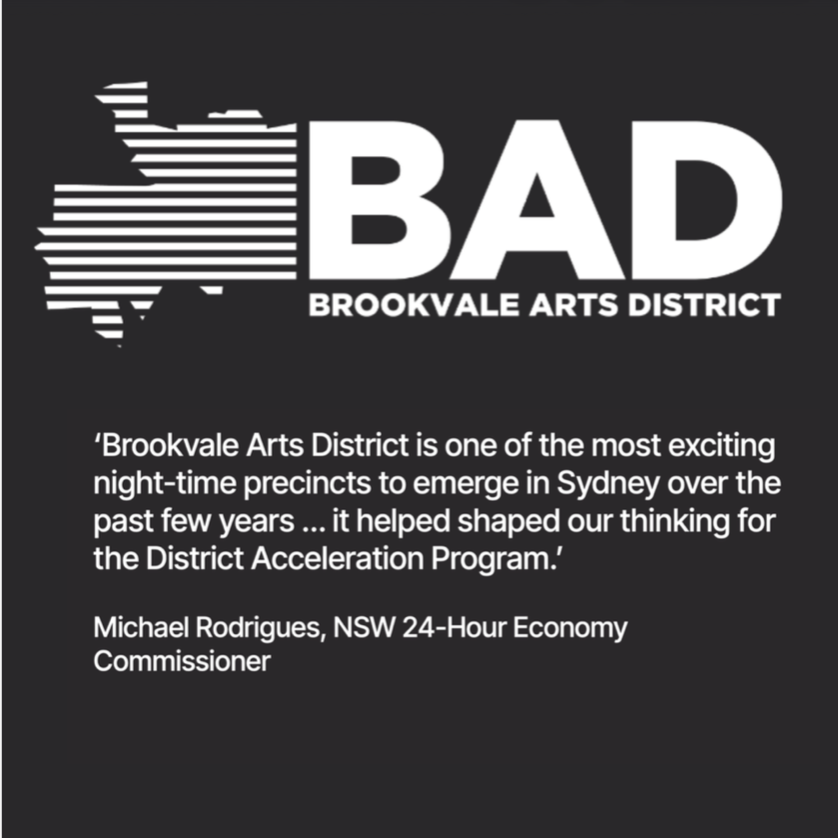
What happens when a place builds on its own culture rather than importing a model from outside? Brookvale Arts District shows how light coordination and shared identity can unlock local energy, investment, and long-term momentum.
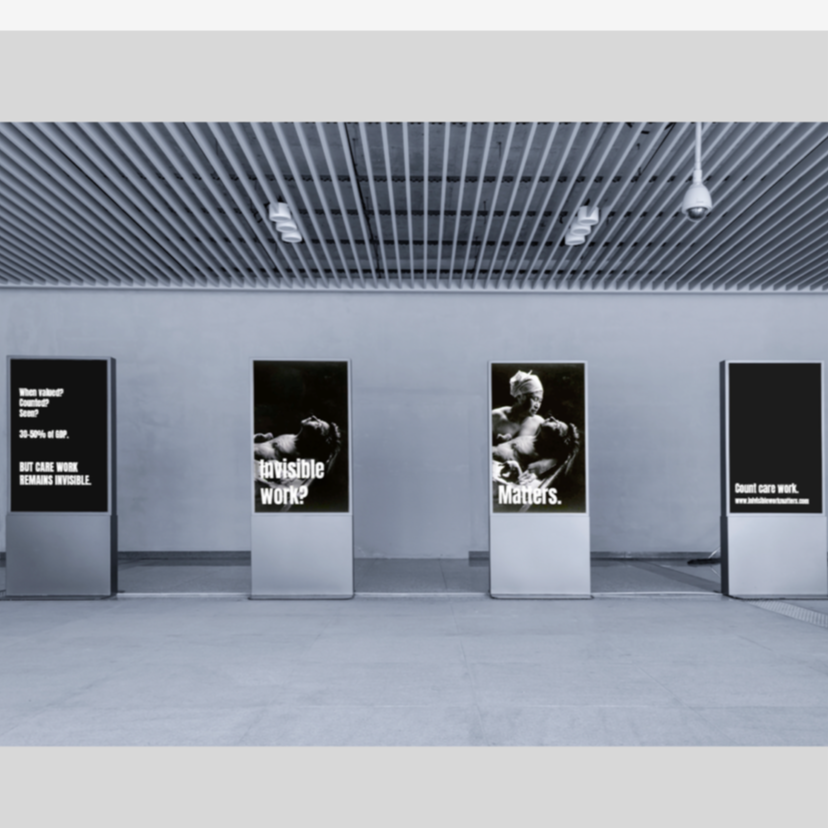
Care work is everywhere — except where economies choose to look. This campaign uses AI-assisted erasure to remove caregivers from familiar scenes, making their absence impossible to ignore. The labor remains invisible; the workers do not.
ICLA Students Are Designing What Comes Next 2028–2032: a possible breaking point, when “normal” no longer holds. As society rethinks labour, trust, and value, our students are asking the most important question: what world do we want to build? And then they begin building it.

Cybernetics matters because it describes how the world actually works: through feedback, adaptation, memory, and self-organisation. These dynamics shape living systems, machines, ecologies, economies, and AI. In this work, cybernetics becomes audible. Rather than composing notes or performing gestures, we design circuits that listen, respond, and play themselves.